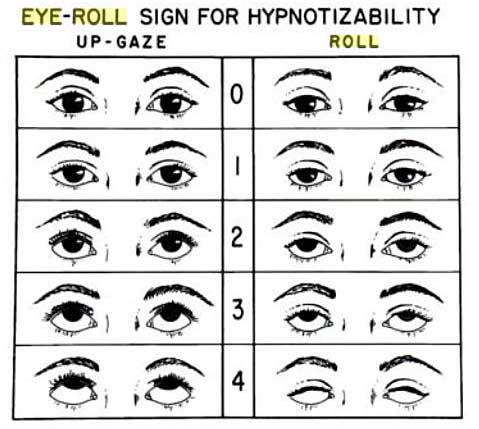
I remember first learning about this in one of the first books I read about hypnosis, and it was probably when I really became fascinated by the concept and appearance.
I’m curious what everyone’s experience is with this, and whether you think this still hold up as an accurate or useful guide to suggestibility. I’ve seen some somnambulists absolutely exhibit the full roll-back with ease while others struggle with even the up-gaze.
I know about this but rarely do it. I agree- I’m not sure how evidence-based this method is. I think the only really good way to test suggestibility is to start doing hypnotic stuff and see how your subject responds.
It is an interesting thing when you look into it. My eyes always roll all the way up, but then again my eyes do that without my prompting. I do it all the time when sleepy and even when in pain.
The Spiegel eye test is pretty simple in theory. Basically the more sclera you show the better the subject you are meant to be. He gives some stats on it in his paper (which you can read here) and they can be seen both ways. He says 75% of the time it gives a correct result on suggestibility but mapping these categories onto something as variable and fluid as suggestibility has a lot of holes in it.
What is also amusing is the fact these categories have names in the Spiegal test. He (and his son who continued his work) postulate that:
1- Apollonians (your mechanics and scientists)
2-3- Odysseans
4-5- Dionysians (artists)
However, various studies have show then test doesn’t really show suggestibility all that well. A paper in the journal of clinical and experimental hypnosis from 1979 gave a very low correlation between the amount of roll and suggestibility. When Ernest R. Hilgard did another test of it in the 1980s it came out slightly better but still not high enough to pass as a useful test of suggestibility.
So while the eye rolling is very attractive and wonderful fetish fuel, it might not be the best tool to use to judge your subjects ability.
Always reblog Harley debunking things
Eyeroll isn’t always present because eyeroll indicates a very profound depth of trance, in my experience. That’s why eyeroll alone isn’t a good yardstick.
As I said earlier, up and down eyeball movements come first, then left-to-right, and then flat out eyeroll. That be how the subjects do in most all cases.

 Ladyandthetrance